


A visit to Santa Maria de Yaviche
A visit to Santa Maria de Yaviche
june 7th, 2004, Santa Maria de Yaviche, Sierra Juarez, Oaxaca, Mexico
written by Johanne Pelletier and Francis Murchison
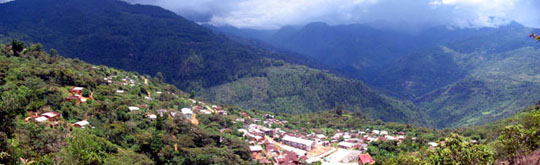
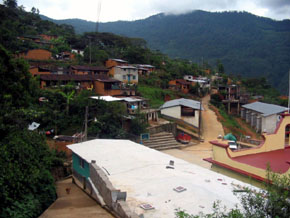
From the city of Oaxaca, we left our bicycles for the bus that took us down tortuous dirt roads through the Sierra Norte for seven hours until we arrived at the village of Santa Maria de Yaviche. Avoiding fallen trees and zones with a high risk of getting stuck in the mud, we passed village after village, moving ever farther into the mountains. This Zapoteco community of 800 people has only one road, the road that goes to the next village and on to Oaxaca. Small footpaths filled with flowers and ferns snake the mountain to join every house. We followed Pedro to his adobe abode with a dirt floor. His wife Francesca welcomed us with the local drink, a hot coffee mixed with panela . We slept on a mat on the floor in his daughter’s house next-door.
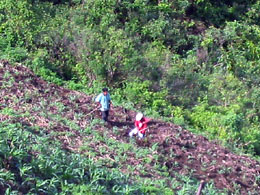
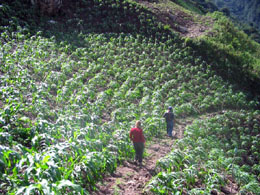
The next day, Pedro left us to clean his milpa . Every family has their small piece of land where they cultivate maize, beans, and squash, the basic food of the community. “Here we cultivate to eat,” Pedro tells us. Every family has their patch of land, which allows them to live. Life is simple here and flows at the speed similar to the growing maize. Following the knowledge of their fathers and grandfathers, the men and sometimes the women go through the stages of burning (quema), seeding (sembra), cleaning (limpia), and harvesting (cosecha). The women mostly take care of the kitchen, the cleaning, the children, and their small garden.
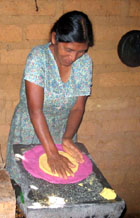
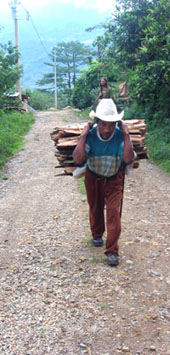
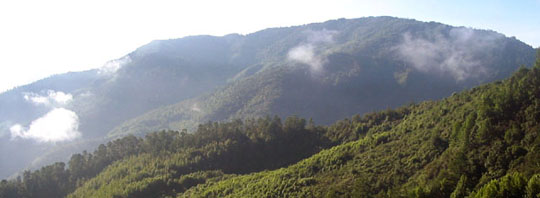
That afternoon Flavio’s family took us in with a good bed, kindly lent. The mornings are clear; one can see far over the mountains and into the depths of the valley. The vibrantly green vegetation perfumes the air with crisp freshness. Flavio’s wife, whose long hair falls to her knees and is knotted in a long braid, piled wood for the kitchen and tended the turkeys and chickens. Afterwards, she prepared enormous handmade tortillas over a wood fire. Late every afternoon, gray clouds sweep rapidly up the valley and the rain begins to fall.
During our stay, many families invited us to eat in their humble and charming homes. This allowed us to meet different members of the CIPO who shared their daily life with us as we savored the best handmade tortillas, made from the reddish corn that they grow. With many conversations and numerous questions, we became very inspired by their social organizing that is nourished with traditions of solidarity and communal life. All the people that we met had a high sense of their responsibility towards the community and nature. According to the system of community rules, usos y costumbres, all men between eighteen and sixty must carry out an obligatory social service, which is unpaid work for the benefit of the community. It can consist of caring for the community forests, serving as community treasurer or as a member of the committee for potable water, as well as other possible positions. Although the system of rules is more complex, the responsibility towards the community grows with the years
What’s more, the people practice tequio, which is a form of collective and volunteer work as labor for the community. A representative sets the day for the tequio and all the men in the village go to work together for the benefit of the community in the construction of a school, a bridge, or a road for example. Another tradition is that of the guetza, which is volunteer work that one person will do to help his neighbor to sow the milpa for example. Later when it’s his turn to sow the milpa, the neighbor will take his turn helping out.
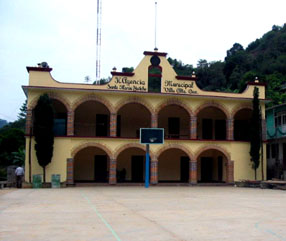
The village has sufferedSunday after sunset, we assisted a meeting of the CIPO grassroots Council in Yaviche, in the house where the coffee beans are toasted. Coffee represents one of the only sources of revenue that permits for the purchase of goods from the exterior and every family cultivates it. Twenty people were present in the dimly lit factory, some standing, others sitting on benches or sacks of coffee. They spoke among themselves in Zapoteco and told us in Spanish that they are happy we want to disseminate information about the situation in the village.
After a long moment of deliberation in Zapoteco, a young man is chosen to tell us about the crises that have troubled the peace in the community. Everything began when a cacique became president as a candidate for the PRI (Institutional Revolutionary Party) for the municipality of Tanetze de Zaragoza that includes the villages of Yaviche and Tanetze. The president, Jacobo Chavez Yescas, and his entourage managed to profit from an already corrupt management system to commit fraud, retaining municipal funds that were destined for development in Yaviche.
Previously, eight neighboring villages lived in conviviality and had organized through Pueblos Unidos del Rincon de Sierra Juarez. Together they demanded that the government build a road to the numerous mountain villages. Pueblos Unidos had organized the project to develop a bus cooperative for transportation from the communities to the city. The new president wanted to get rid of Pueblos Unidos and attempted to compel Yaviche to support his movement. Meanwhile, the members of the community in this little mountain village decided to organize and form a free municipal agency during the year of 2001. They did so with the support of the Popular Indigenous Council of Oaxaca (CIPO).
An escalation of conflict and repression toward the community of Yaviche followed. The president of Tanetze refused to recognize the free agency. The tension rose and in January 2002 forty-six men, of whom twenty-nine were from Yaviche, were sequestered under the orders of Jacobo Chavez. They were locked up for five days in bad conditions involving brutality and threats to their lives. No judicial consequences were levied against the perpetrators of these violent acts.
During this time, the village organized with the CIPO and obtained their funds directly from the government after becoming a free agency. A secondary school was built and many other projects were put to action. Yaviche finally received the official papers which define its territory.
the Municipal AgencyMeanwhile, in spite of the change in presidency in the village of Tanetze, the cacique Jacobo Chavez continued to threaten Yaviche. Two men from the village who were receiving money from the cacique disagreed with the formation of a free agency, refused to fulfill their obligatory social service, and attempted to convince other members to reject the CIPO. The people of Yaviche met in an assembly to decide what to do with the two traitors of the community. They chose expulsion and kept the houses as communal goods. However, the two men came back to their homes in spite of clear warnings. They were arrested and imprisoned on the 15th of October 2003.
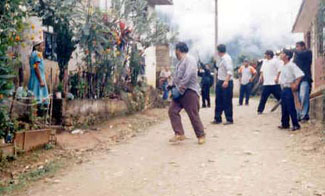
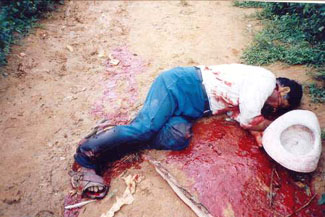
On the morning of October 16th, 2003, the whole village held a general assembly to decide what to do with the detainees. Around 11am, trucks reached the road that passes above the village. Thirty men armed with guns descended into the village on foot, shooting. Jacobo Chavez was recognized among the people present during the attack as well as many other men from Tanetze. Also present were a group of paramilitaries called the CROCUT (Consejo Regional Obrero Campesino y Urbano de Tuxtepec), accompanied by their chief Cesar Toimil Roberts. Many men from Yaviche ran towards the shooters carrying sticks and stones to prevent them from occupying the agency and to keep them away from the primary school. Nine men of Yaviche were shot and one man, Bartolome Chaves Salas, was brutally killed by gunshot and machete cuts.
Involvement of the State
The Oaxaca State government whose governor José Nelson Murat Casaab, like Jacobo Chavez, is an Institutional Revolutionary Party member supports these barbaric acts. This government encourages the repression of indigenous communities who organize to claim their rights. Multiple elements show the involvement of the government in this affaire.
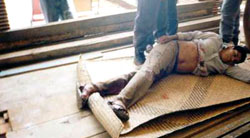
First of all, the nine men with bullet wounds were transferred by ambulance four times because the medical authorities, who answer to the government, refused to treat them. A private hospital finally agreed to take care of the wounded after many hours of suffering.
Second, during their brief stay in the second hospital they passed through, two of the injured were pressured by two government functionaries to sign a false declaration about the attacks. One of the wounded men had seven bullets in his body at this time.
Third, the authorized arrest warrants against the attackers have never been carried out. The villagers of Yaviche know their neighbors in Tanetze who perpetrated the attacks and who continue to live with all impunity.
Fourth, César Toimil Roberts as well as high-level government functionaries such as the Secretary and Under-secretary of native affaires Candido Coheto Martinez and Mauro Francisco Méndez command the CROCUT paramilitaries. None of the paramilitaries who participated in the attacks have been arrested.
Fifth, no compensation has been accorded to the wounded. The nine injured spent a long time unable to work, a serious consequence for those who must cultivate to feed their family. During our stay, some of them had just begun to move around. Another man, Onofre Manzano, whose tibia was burst by a bullet, will remain disabled, without being able to work in the milpa, a physically demanding task.
Sixth, government representatives are currently trying to convince the village of Yaviche to withdraw the charges on the attackers and to make “peace” with the whole story.
On the side of the media, the reported story is purely constructed, describing a confrontation between the two villages, accusing the members of the CIPO of violence, and omitting of course the fact that all of the dead and wounded are from Yaviche.
Before the attacks, the whole community belonged to the CIPO-RFM. After the events of October 16th, many people have left the CIPO, some for fear and others because of the kind of participation that this type of organization requires. In fact, after the attacks, the CIPO organized protests and occupations with all of the communities that belong to the Council to demand that the government seek for justice in the affair.
During our stay, we met with the wounded and other members of the CIPO who were present during the attacks of October 16th, 2003. Many months after the events, no repercussions have been applied to the attackers. The members of CIPO continue to demand that justice be done all the same. They are nonetheless satisfied of the changes that have come from their integration in the CIPO and have much hope for the future of their village. They continue to organize for the improvement of living conditions in the community while maintaining the way of life and traditions of this village in the middle of the mountains.
Santa Maria de Yaviche
Santa Maria de Yaviche, Sierra Juarez, OaxacaConsejo Indígena Popular de Oaxaca «Ricardo Flores Magon» CIPO-RFM
Calle : Emilio Carranza #210, Santa Lucio del Camino,
Oaxaca, México C.P. 71228
Tel/Fax : + (00 52) 951-51 781 83
Tel : + (00 52) 952-52 781 90
email : cipo@nodo50.org, ciporfm@yahoo.com.mx
www.nodo50.org/cipo
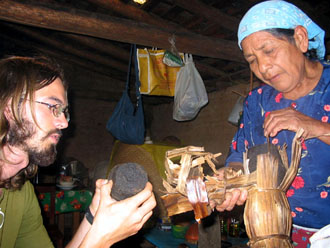 Francis and Francesca : panela |
|
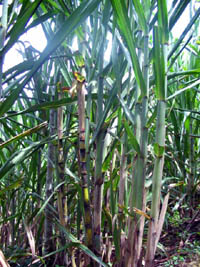
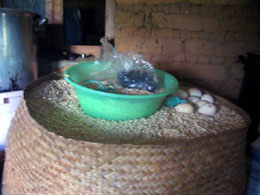
| Panela is traditionally made from sugarcane. The cane is cultivated, cut, and pressed to extract the juice. The liquid is boiled all night and in the morning the hot mixture is poured into a mold. After cooling down, the villagers wrap the panela bricks in sugarcane leaves and store the precious ingredient above the wood fire. |
 |
 |
 |
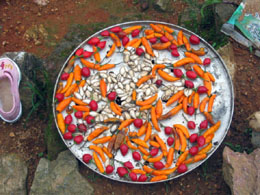 |
| The milpa is sthe primary Mexican agricultural system for the growth of maize. In the milpa, the maize is associated with at least two other plants: the bean and the squash. Frequently, hot peppers are also included in up to twenty-five different species. Each plant accomplishes an important function. The beans harness atmospheric nitrogen in the ground to feed the maize in the following year and the maize provides a stem on which the beans can wind to grow. The squash prevents the growth of weeds and its large leaves that lie on the soil conserve its moisture. The milpa must adapt to the characteristics and limits of the place where it is grown and humans try to compensate using innovations and different combinations. Unlike monoculture, the milpa grows in some harmony with nature. |
|