

National Network for Consumer Defense (NNCD)
November 30 th, 2004 , Managua, Nicaragua
Written in english by Johanne Pelletier and Francis Murchison
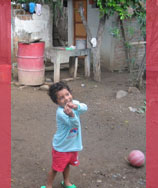
The UN development program’s 2003 report showed the following figures concerning Nicaragua:
44 th poorest country in a list of 94 developing countries;
24.3% of the population is affected by poverty;
1.2 million inhabitants have no sustainable access to clean water (connection to home, public fountains, wells etc);
33.2% of inhabitants over fifteen are illiterate;
4.3 million inhabitants have a daily income per capita of 1 US dollar or less;
94.5% of the population earn only 2 US dollars or less per day.
-------------------------------------------
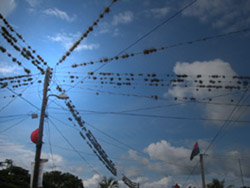
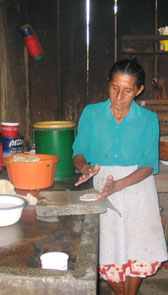
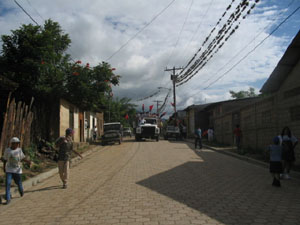
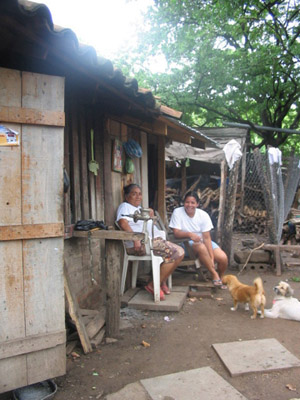
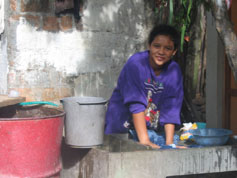
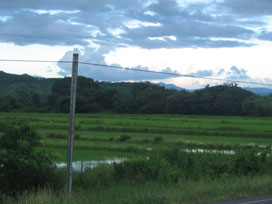
Upon our arrival in Nicaragua’s northerly Somoto where the power lines are covered in a dense growth of climbing plants, Ana Luisa welcomed us into her home to share day to day life in the companionship of her family. Every morning this kind mother awakes bright and early to begin her day with the important task of filling up several water barrels in the backyard. Because the water service in Somoto is very unreliable, coming only in the morning for two hours or so and sometimes in the afternoon, Ana Luisa must fill the barrels or face spending the day without water to drink, or to cook, or do the laundry, or bathe. This water ration is shared among her children, nephews, sisters, brothers and parents, who add up to twelve, all sharing the small three-room house. The family gets by selling tortillas in the neighborhood where in truth the residents are better off than many Nicaraguans. In some regions the water only comes once a week or not at all. In fact, the large majority of Nicaraguans are constantly concerned with having enough to eat and drink in order to survive from one day to the next.
Citizens all over the country have most recently been faced with the knowledge that their government has decided to privatize water services, putting in doubt the already uncertain future of water in Nicaragua . As is currently the case in Nicaragua various well-known international actors take a central role in the process and the advancement of privatization in third world countries.
Managua
Following the Pan-American Highway we arrive in the chaotic capital city of Managua, remarkable for its lack of urban planning. The city has no street names and the poorest shantytowns can juxtapose the richest neighborhoods.
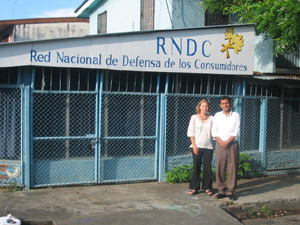
Lost in the urban sprawl, we assist a meeting of the National Consumers’ Defense Network, an organization that has been leading the fight against the privatization of water in Nicaragua for two years now. Around the table we see members of all sectors of civil society who have come together to talk about the situations in their municipalities and departments and work on solutions. This network dedicates its efforts to the representation of the country’s citizens and having their rights respected as consumers. To this end they follow no political party, in order to maintain their own agenda un-compromised. The nationwide Community Movement or Movimiento Comunal whose organizing forms the grassroots base of the Sandinista Party is also organizing against the privatization of water services and participates together with the National Consumers Defense Network on occasion.
The activists of the Network have constructed a proposition consisting of a real alternative to water privatization. As they see it, water is a good, a natural resource, and a public resource, which should not be managed for profit but for social interest for the survival of the environment and the human population. The management of water under responsibility of the State insures public health, social equity, and the sustainability of this natural resource. Following these principles, they have put together a proposition for a General Water Law that aims to insure the rights of Nica citizens to water before the Nicaraguan National Assembly. Should this law proposition be ratified not only would water services remain public, but environmental projects would be set underway to ensure the maintenance and durability of the resource in the future to assure good quality and sustainable water services for generations to come.
Where did the privatization begin?
In the eighties the Sandinista revolution overthrew the Somoza dictatorship and endeavored to install a socialist regime. In 1990, the Sandinista party lost the federal elections due to continuing military intervention of the Contras who were financed and trained with the support of the Reagan government. Violetta Chamorro became the new president of Nicaragua. At this point, the World Bank and the International Monetary Fund (IMF) began to pressure the Nicaraguan government to sell off the countries public services. The pressuring was rooted in the negotiations of the Nicaraguan international debt and has increased over the years. Recently the right wing regime of Ex-President Arnoldo Aleman, turned out to be quite susceptible to the pressuring of these international organizations.
In the process of pressuring for a re-dimensioning of the State, the IMF and the World Bank argue that the sale of public services will increase the efficiency of the services, augment the coverage to reach more citizens, and lower production and distribution costs through a private operator. These gains would then reduce the public sector’s deficit and improve the administration of the national budget.
In reality, there are several elements that the IMF and WB ignore in their arguments that are based on neo-liberal theory rather than experience. First of all, a State run society has a responsibility to the population according to its charter contrary to a private company whose main concern is to profit or at the very least, to recuperate its investment. The easiest way for this goal to be achieved is to increase consumers’ fees. Because Nicaraguans are not in a position to stop using water services the enterprise has the luxury of a natural monopoly and the security that its client base will not reduce. Experience tells the tale; following the privatization of telephone and electrical services in Nicaragua users were confronted with dramatic increases in service costs.
Second, a private company, or more aptly put: the transnational corporation, has no social mandate; especially not to be charitable to the poor. The proponents of privatization claim that services will reach more citizens under a private operator. In reality the company cannot justify making the considerable investment required to extend services to far-flung, rural populations. To put it simply, these small rural communities would not consume enough water for the investment to be a lucrative one.
Third of all, Nicaraguan citizens essentially paid for the existing infrastructure with their taxes, the sale will most likely be done at a fraction of the price. The example of the sale of public phone and electrical services in Nicaragua illustrate this perfectly; the services were given an estimated value of 500 millions US and were sold for only 180 millions.
Fourth, the whole privatization process is conducted with a complete lack of transparency; the citizens, who essentially own the service, are not consulted on the matter.
Fifth, following the sale to a private enterprise the country will find itself without the considerable income that the services had provided as publicly owned operations.
And last of all, as far as the income for sale of public services goes, most of the time the money goes towards the payment of interest on the country’s international debt if not into the pockets of government officials!
On the process to privatize the water…
The formation of ENACAL (Empresa Nacional de Acueductos y Alcantarillados) as a state owned enterprise in 1997 was the first step in the process of privatization. ENACAL took over the control of services from the Nicaraguan Institute of Water and Sewage services (INAA Instituto Nicaraguense de Agua y Alcantarillados) which now became a regulatory institution overseeing water services. The key point in the change is that as an enterprise ENACAL could possibly be sold in the future, or could contract out its services to the private sector. This first step is the starting point in a long process towards privatization whose steps were purposefully hidden from the public.
During the encounter we attended in Managua, individuals representing different regions told us about the degraded situation of water services in their areas. In Matagalpa, for example, water bills are high and citizens are being billed for sewage services that don’t exist. In rural Ticuantepe, the municipality contains the countries largest watershed but many citizens are overcharged or simply receive no water at all. The citizen spokespersons from Ticuantepe told us ironically how; much of the water is diverted for the irrigation of ex-President Aleman’s farm Rancho Chile. The privatization process saw to the creation of ENACAL, but as the citizens’ claim through the Network; ENACAL does not properly perform its role. For example, ENACAL has repeatedly neglected to pay its electrical bills for water pumping in Managua leaving citizens without water on numerous occasions. The supervision of the INAA, which is supposed to watch out for the respecting of consumer’s rights, remains deaf to the complaints from the citizens about the diminishing quality of water services. The collaborators in the Network are convinced that the government is conscious of the problems with water services and declines to act to improve them in order to justify privatization, arguing that the services are irremediably inefficient in their hands.
Meanwhile, claims from all over the country accumulate in the hands of the Network where unison brings force.
The Case of the Inter-American Development Bank (IDB)
Pushing in the same direction as other international financial institutions the Inter-American Development Bank approved a loan to Nicaragua for 13.9 million US dollars over five years starting in the year 2000 (project 1049/SF-NIC). The objective of this loan was to reform the provision of Water and Sewage Services through the ‘modernization’ of ENACAL. This reform implied an ‘institutional strengthening’ aiming to change the State owned enterprise into a shareholders venture. Almost all the money from the loan was to be used to pay a private company to take care of the ‘commercial strengthening’ of water through an administrative contract. The country hereby fell farther into debt through the loan while ENACAL simultaneously lost its most lucrative department, namely its administration.
This project financed by the IDB requires a contract with a pre-qualified business. On the list of qualified companies we find the big transnational corporations in the water business, among others the American owned Latin Aguas-Earth Tech Consortium that has investments in over a hundred countries and the Societé des Eaux de Marseille/Lyonnaise des Eaux – Asociated Services from France. By the end of the five-year term this company was to assist ENACAL in the process of finding a buyer willing to take over water services for good.
After months of continuous public uproar in Nicaragua Law 440 was adopted in December 2003. This Law specifies that no concessions to private entities will be permitted nor will administrative contracts to third parties be issued until a General Water Law has been adopted. In the declaration on the state of execution of the project, issued by the IDB in January 2005 certain changes were outlined due to the introduction of Law 440. All privatization aspects of the project seem to be suspended until a General Water Law that specifies in detail the participation of the private sector is approved.
Water under the bridge
After the meeting with the collaborators of the national consumers defense network was over, we sat and talked with Santos Salvador who is deeply involved in the fight for the protection of consumers’ rights. In reference to all the restructuring of the State towards privatization he reminded us that these changes are the conditions to the signing of Free Trade Agreements such as CAFTA (Central American Free Trade Agreement) that should be ratified in 2005. As such the government follows these neo-liberal politics that serve the interests of transnational corporations from developed countries. The mentality is that foreign investment will be the chief driving force of development in the third world in spite of the fact that these investments undermine the national economy.
In other countries such as Peru and Bolivia the privatization of water services set off a resounding popular reaction. The streets filled with angry citizens indignantly asking ‘when will they privatize the air?’ In both countries the sheer force of popular mobilization caused reversals of the one sided decisions to privatize this common good and severely shook the governments in power.
In the 80’s the Nicaraguan people rose up in the Sandinista revolution to fight against a dictator. As we saw in our visit, the sense of solidarity is still strong. Similarly to what happened farther south in Peru and Bolivia Nicaraguans have come together to prevent water privatization for the time being. During our passage through Nicaragua citizens found out that transnational water corporations were making offers to the government for the purchase of water service sectors. If the government continues to act against the needs of citizens on this matter it risks lighting a fire that cannot be extinguished with water alone.
Red Nacional de Defensa de los Consumidores (RNDC)
Semáforos de la Asamblea Nacional
300 mts. Abajo 1c. Al lago
Casa # K-114
Managua, Nicaragua
Phone: 222-3472, 222-4112
E-mail: matagalpa@cepad.org.ni
http://www.laredvida.org