

CODDEFFAGOLF
CODDEFFAGOLF
Committee for the Defense and Development
of the Flora and Fauna in the Gulf of FonsecaOctober 31st, 2004, San Lorenzo, HONDURAS
Authors: Johanne Pelletier and Francis Murchison
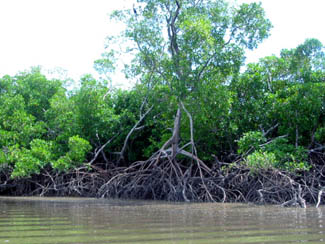
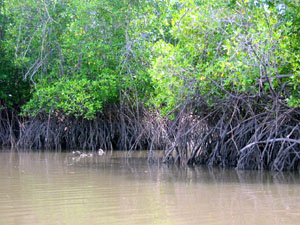
A birdcall rings out, the pelican dives like an arrow from high in the air. In a pirogue, we move forward with the paddle strokes of a young boy and another fisherman whose skin is tanned by the sun, penetrating into this fairy-like forest where the trees, mangroves, stand up on their root-stilts that hold onto the earth, halfway between the water and the land. A woman and her son busy themselves with fishing for their evening meal in the calm waters. The people here have lived simply off fishing for generations. For these Hondurans, the Gulf of Fonseca doesn’t belong to anyone but is shared by all.
The Gulf of Fonseca is a singular place that was declared as the Ramsar 1,000 site by the Convention on wetland conservation in 2002. Here, mangrove forests, lagoons, estuaries, and other coastal wetlands can be found. These ecosystems maintain an important biodiversity and serve among other things as a refuge for migratory birds. Mangrove forests in particular, which have diminished drastically all over the world, are a privileged place for aquatic fauna to find protection and food during a part of its life cycle. The presence of mangrove forests protects the coast against tropical storms and soil erosion. It also protects the water table and the freshwater network and furnishes the local population with wood.
However, the Gulf’s development, envisaged by industries, governments, and international financial institutions has come to represent menace to the way of life of these people as well as the fragile wetlands in which they live.
The invasion of the shrimpers!
In the port town of San Lorenzo, we go to meet with Justo Rufino Garcia, a fishing technician who is also the president of the directive body of CODDEFFAGOLF, the Committee for the defense and development of the flora and fauna of the Gulf of Fonseca. The organization was created fifteen years ago to promote sustainable development and conservation of the Gulf for the most part in reaction to the growing shrimp farming industry.
In fact, the shrimp farming industry is a real archetype of industries that are made possible by the capitalist economic system of our globalized world. This industry would not exist if external costs, such as environmental and social impact were taken into account, in one way or another, as expenses to be paid by the business. However, the development of this industry is encouraged in third world countries everywhere. In their onfiscating language that borders on sadism, the World Bank and the International Monetary Fund’s plans for development announce a financial aid that will “insure a sustainable development and reduce poverty” through shrimp aquaculture in Honduras. The results in the Gulf of Fonseca have instead been environmental damages and an increase in poverty, precarious living situations for the inhabitants of the zone, and previously unknown social violence.
Accordingly, to begin their shrimp farm, the industry must cut the mangrove forest in order to dig ponds. The provision of shrimp larvae is often done by fishing in natural habitat, which simultaneously kills other crustacean and fish larvae. Put in the ponds, the shrimp larvae are treated with antibiotics and fed industrial granulated feed made from fish flour. Wastewater contaminated by fecal matter, chemical products, and antibiotics is then dumped into the Gulf. The industry is profitable for a period of three to five years and allows for a quick harvesting of high profits. Next, the harvests decrease and epidemic risks increase. At this point the industrialists prefer to change location. The degraded location then takes many years before becoming favorable to the regrowth of local species.
Therefore, as a consequence of shrimp aquaculture, the inhabitants of the Gulf of Fonseca have lost their traditional fishing sites, they have noticed a large decrease in fishing stock because of pollution and the capture of larvae, and their living condition has been degraded. More than a dozen fishermen have been killed by the armed guards that watch over the aquaculture ponds. This outcome doesn’t include the important damage realized to the flora and fauna in the Gulf of Fonseca.
CODDEFFAGOLG counter attack!As Justo told us, the inhabitants of the Gulf didn’t stand by with their arms crossed, they organized themselves as the industrialists received land concessions from the Honduran government. As a result of their pressuring this same government declared multiple protected areas in the Gulf. CODDEFFAGOLF succeeded in obtaining three moratoria on economic development, of which one is on shrimp aquaculture. Unfortunately, the industry has continued to illegally build new aquaculture operations.
Furthermore, in reaction to the government’s inertia to protect the country’s resources, the organization has planned its own network of surveillance. Divided into sixteen committees to cover the Gulf’s territory, each zone has a volunteer who reports daily by radio to the offices in San Lorenzo. The guard is in charge of watching for irregular activities that could be harmful to the flora and fauna, and to notify the local authorities in case of an emergency.
Thanks to international aid, the organization has begun numerous sustainable development projects such as the farming of the Tilapia fish and of watermelon. They have also begun a documentation center in the San Lorenzo offices. CODDEFFAGOLF has participated in equipping the city of San Lorenzo with garbage bins and creating a dump for the different communities around the Gulf. They are active in developing an environmental consciousness among the fishermen and the other inhabitants of the Gulf of Fonseca.
Justo, who is quite inspired by the participation of local fisherman, told us how, in order to sway the government, CODDEFFAGOLF has organized protests in Tegucigalpa where more than 30,000 people were present to demand the protection of the Gulf of Fonseca. The organization has also joined protests against the Free Trade Area of the Americas (FTAA), government policy for privatization, and the Plan Puebla Panama (PPP).
Lastly, in spite of the lobbying of industries such as Ultramares, a subsidiary of a Canadian mining company, CODDEFFAGOLF continues to fight for the protection of the fragile ecosystems that make up the Gulf of Fonseca. The local inhabitants and fishing people put their hearts into it so very much because it is the conservation of their way of live and their very survival that is at stake.
CODDEFFAGOLF
Comité para la Defensa y Desarrollo de la Flora y Fauna del Golfo de Fonseca
Bo. El Centro, San Lorenzo, Valle
Tel/Fax: (504) 881-2016
www.coddeffagolf.org