


SINTI TECHAN
SINTI TECHAN
Citizen action network faced with commerce and investmentOctober 31st, 2004, San Salvador, EL SALVADOR
Authors: Johanne Pelletier and Francis Murchison
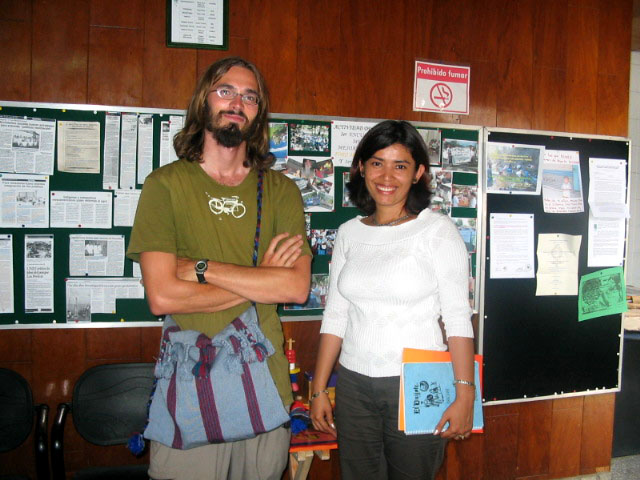
During our passage through El Salvador, we made a short stop at the capital to learn more about a network that was formed not long ago. It is the SINTI TECHAN citizen action network faced with large scale commerce and investment; Sinti Techan is a term that means “maize of the people” in the native Nahualt. In the offices of UNES (Unidad Ecologica Salvadoreña or Salvadorian Ecological Unity), we met with Nidia Hidalgo who briefly introduced us to what is happening in El Salvador with the oncoming Central American Free Trade Agreement (CAFTA), the Free Trade Area of the Americas (FTAA), and infrastructure mega-projects such as Plan Puebla Panama (PPP).
First of all, the network includes a large ensemble of organizations who work in different areas and on different themes but who integrate themselves in an effort to influence the rules and processes concerned with commerce and investment. Among the organizations involved we find Las Dignas, a women’s group that works on the issue of the maquilas and the CEAL (Centro de Estudios y Apoyo Laboral or Center for studies and labor support) who are concerned with workers rights. A number of organizations in the network fight for human rights such as ASAFOCAIS, Nueva Generación XXI (New 21st Generation), and the Bloque Popular Juvenil , engaged in the reinsertion of street children and youth who turn towards delinquency in urban areas, attracted by the “Maras”, gangs. The UNES works to make the connections between commerce and the environment while Oikos and the Red Ciudadana Frente a los Transgenicos (Citizens Network against genetically modified organisms) is involved in educating citizens and farmers about food security and bio-security through alternatives such as organic agriculture and the preservation of local seed varieties.
Together the participants compose a consensus-based network that functions horizontally, is decentralized, and has no hierarchical structure or formal decision-making body. They have an annual general assembly to decide the overall direction to be taken. A coordinating team is then formed and meets weekly, aiming to involve the member organizations according to their themes and the situation at hand. They try to coordinate their efforts on regional, continental, and global levels, for example through the Continental Social Alliance and the World Social Forum.
Lately, they have published a book of reflections on the potential impact of the Central American Free Trade Agreement and its alternatives, which is by the way, available online. According to them, this commercial Agreement is above all determined by a mercantile logic that considers the pursuit of profit to be a value superior to all others. The Agreement is also characterized by an absence of emphasis on human rights and environmental protection and makes national interests subordinate to foreign economic interests.
What’s more, Sinti Techan points a finger at the anti-democratic negotiation processes that are conducted without any transparency excluding social sectors and a large part of the business sector (micro, small, and medium enterprises). Faced with the confidentiality of these negotiations, the network attempts to educate the civil society and the deputies who will vote at Congress in order to incite social mobilization.
Finally, although too few people are aware of what is coming with the Central American Free Trade Agreement, the Sinti Techan network struggles persistently to make information accessible for the people of El Salvador. Their dream is to “Democratically build a sustainable development project on national, Central American, and global levels, that will permit the people to enjoy their fundamental human rights”.
Red de Acción Ciudadana frente al comercio e inversión – SINTI TECHAN
Email : sinti_techan@yahoo.com
Telephones (503) 260-8612 or (503) 260-8613
www.redsintitechan.orgUnidad Ecologica Salvadoreña (UNES)
Email: coord.unes@telesal.net