

Xulum Chon Cooperative Society
Xulum Chon Cooperative Society
July 31st, 2004, Oventik, Chiapas, MEXICO
Authors: Johanne Pelletier and Francis Murchison
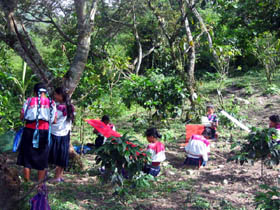
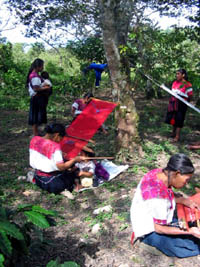
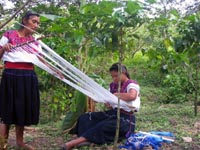
On a sunny afternoon, women of San Antonio Brillante, accompanied by their children, came together under the shadow of a tree to weave. In the peaceful splendor of midday they attached their looms around the waist and began to move their agile and experienced hands over the colored threads. As these ten workers wove, speaking and laughing amongst themselves in the Tzotzil tongue, one of them spoke to us about the Xulum Chon.
In fact, the ancients say that it is told that long ago an animal blocked the junction formed by the coming together of three rivers that crisscross the valley. The valley therefore slowly filled with water until the trees and houses were covered. The ancients say that it is told that their ancestors called upon the Xulum Chon, a blind animal with a horn and long claws. This animal unblocked the trees, mud, and the rocks to allow the three rivers to pass.
The intertwining threads
The Xulum Chon Cooperative handwork society bears the name of this animal and unites the women of eight communities who live in this same valley. The cooperative began in 1998 and was legalized in 1999. It was created for export towards the United States, Canada, and the European Union where their work could be sold for a fair price, while in Mexico the handwork is sold at derisory prices. Previously, women who wished to sell their weavings and embroidery had to go through a coyote or go into the city itself.
In the cooperative, women work in groups within their communities and meet every week to weave and embroider. The money received from the sale of craftwork is collectively distributed among the members of the work group where they were made. The work is sporadic, and is done when these women aren’t occupied with other tasks such as the coffee harvest, taking care of the children, the garden, the house, or the kitchen
The workers whom we met with in San Antonio del Brillante told us about their condition as women. They recounted how before the Zapatista uprising in 1994, women almost never left their homes. Now, some of them claim their rights, participate in assemblies, and are remunerated for their work. The cooperative gives them the opportunity to come out of their homes, to spend time with other women, and to learn different things. For the most part, these women have no school education and do not speak Spanish very well. Participation in the co-op allows them to speak Spanish, to do the administration, and to meet people from other places, all within their boutique, which is situated in the Caracol of Oventik. Nonetheless, they need their husbands’ permission to leave the village.
Artists well rooted in tradition
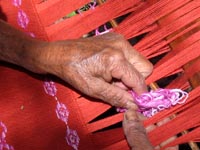
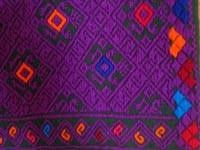
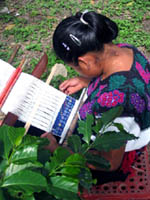
Underneath wrinkled hands and underneath novice hands, the thread runs to form a design. In this group of women of all ages, the youngest receive the help of their elders who teach them the rudiments of the art of weaving and embroidery. Little girls starting at a young age watch their mothers reveal the traditional patterns along the thread of time, forming the most beautiful motifs as the colors chosen by the artist come together.
As well, the women told us how their traditions are important to them and how they work to conserve them. “Tradition is our way of doing things, it is what we know how to do and do not want to change, because it is part of who we are,” the work group representative said to us. In their day-to-day lives these same women proudly wear their fine-looking traditional clothes that they themselves have embroidered over the course of many months.
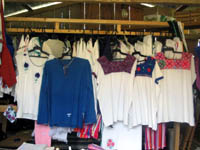
A piece that requires up to five months labor to make and for which the material costs about 90 pesos would be sold in San Cristobal for between 200 and 350 pesos. This is no encouragement for these artists to continue with their trade.On the other hand, with the cooperative, they have managed to export batches bringing in 4,000 to 5,000 pesos by mail to the United Sates, Switzerland, and Italy. Following the needs of their buyers, they have begun do some simpler work, which is more suited to their client’s taste. In their store, they sell blouses that they make by hand in three weeks’ time for 120-150 pesos (12-15 $ US). They also weave pillowcases, tablecloths, placemats, bags, and scarves.
Although to start out the Society had 200 members, only 78 remain. Because there is no market for their goods, many women have left the cooperative. With the collective structure, more needs to be sold for each individual to receive a significant amount. Nevertheless, there is no inequality in distribution of the revenue from sales.
In summary, the Xulum Chon Cooperative Society has been working for some years now in an attempt to export craftwork of embroidery and weaving that is traditionally made by the women of the municipality San Juan de Libertad. Artists, they have managed bit by bit to change the condition of women as they learn many things within the cooperative and as they come out of their homes to meet. Nonetheless, there are not enough buyers for their work to bring significant revenue to the home. They thereby remain in search for a market for their handwork and hope that one day their work will contribute to improve their quality of life.
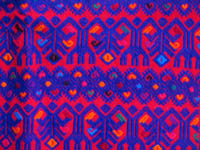
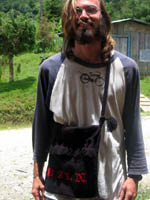
“Wow! Francis, look at that great looking bag!”
“It’s really well woven, Johanne, and what colors…”“And the shirt, my sister would be beautiful in that!”
“Someone should start selling this Xulum in Canada…”

“Dude!”
Contact the Sociedad Cooperativa Xulum Chon via
DESMI, A.C.
Calle Flavio A. Paniagua No. 79.
Barrio Guadalupe, 29230. San Cristóbal de las Casas,
Chiapas, México
Tel : 01967 678 12 48
www.laneta.org/desmiac/index.html
email: desmiac@laneta.apc.org