

SINTTIM
SINTTIM
Sindicato Independente de Trabajadoras
y Trabajadores de la Industria Maquiladora
april 30th, 2004, La Paz, Mexico
written by Johanne Pelletier and Francis Murchison
A Dance with the Governor
In the heat of springtime, Teresa goes to the workers’ festival where she sets eyes on the new Governor for the State of Baja California Sur, Leonel Cota Montaño. Today, she tells herself, she will take the chance. In a courageous move, she sets out to invite the Governor to dance. He joyfully accepts but, on their way to the dance floor, a representative of the enemy union attempts to prevent Teresa from joining the waltz. The little woman simply continues toward the dance floor and enters the swirling dance on her gentleman’s arm. Among the throng of laughing dancers, Teresa explains to Leonel that for a long time now her union has been fighting to become registered which would accord them legal status. A few weeks later, the independent union received an audience with the Governor. More than a hundred workers showed up at the government palace to support the SINTTIM (Sindicato Independente de Trabajadoras y Trabajadores de la Industria Maquiladora) which achieved registration on August 30th, 1999.
Towards the Creation of Independent UnionismMuch before Teresa’s dancing tipped the scales in the favor of SINTTIM, the workers in the maquila had needed to organize for the respect of their rights with the utmost discretion vis-à-vis the current labor unions and bosses. Here, the initial experience of unionization goes back to 1973 when the first textile maquila, Ardemi de La Paz, came to set up shop in the region. The 45 maquileros endured bad treatment, sexual harassment, and went unpaid for their work. The employees fought to form a union, and after a strike the factory closed down. The workers continued to struggle and succeeded in getting the government to buy the factory. Twelve years of independent unionism along with good working conditions followed, until the government closed the factory bringing an end to the union 26 de julio.
After this first episode, other maquilas began to appear in the area with dire working conditions. In the recent years, we find California Connection, established in 1994, a maquila of north American capital producing Wal-Mart’s clothing lines, Baja West, founded in 1999 also produces clothing, and Punk Kook, of South-Korean capital, opened its doors in 1995 for the making of bags for Adidas and Patagonia (two companies that belong to the Fair Labor Association, dedicated to respecting the Code of conduct of the ILO (International Labor Organization)).The Workers of these maquilas are 80% young women or single mothers who will tolerate the abuse due to their precarious living situation. Generally speaking, these women work schedules that can be from 7:30 a.m. until 9:00 -10:00 p.m., undergoing harassment should they refuse this obligatory overtime. These women must pay for their drinking water and toilet paper, and the managers count their trips to the washroom. Most of the time, the employees don’t know that they are members of a union nor who their union representative is. The only trace is the union fee that is deducted from every paycheck. The official unions, the CROC (Confederación Regional de Obreros y Campesinos) and the CROM (Confederación Revolucionaria de Obreros Mexicanos), are strangers to the workers and help only the company heads. They are called protectionist unions or charros. Others, called blancos, are created by the bosses themselves. All of these unions are the holders of the collective contracts and the employees know neither what they contain nor the date for revision.
To challenge these conditions, the workers formed the Union of Women and Men Workers of the Maquila (Unión de Trabajadoras y Trabajadores de la Maquila) in 1993, an underground network of small groups that fight for their rights. The group of workers and companions that we met laughed in remembering this period of hidden pamphlets and secret meetings. In 1998, the SINTTIM was formed in spite of the control held by the charros unions. All the employees on the board of directors were fired unjustly. Finally, being registered, the union has legal recognition and can act to be sure that the Labor Law (Ley Federal del Trabajo) is applied.
The current lucha, grrr…Since 2003, all the maquilas in southern Baja California have closed down their operations. Normally when an enterprise closes its doors, it must pay a minimum of three months salary in compensation. These companies left, leaving behind an abandoned building, sometimes with the machines on site. In order to receive their money, the workers need to sell the building. Currently, the SINTTIM is helping to reclaim what is due to the workers through the sale of the California Connection buildings in Constitución and La Paz. Six hundred workers were abandoned a year ago, and have organized themselves with their independent union to receive their severance pay after the sale. The SINTTIM also gives legal assistance to workers in the agro-maquiladoras (outsourcing food packaging factories) that remain in operation.
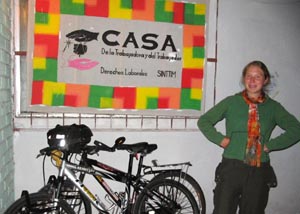
Even though the maquilas have disappeared, the SINTTIM continues its activism for the application of workers rights. The ten or so, mostly women, workers that we met in the Casa de la trabajadora y del trabajador, know by experience that capital moves but that it always finishes by coming back. The union doesn’t plan to disappear, because the maquiladora industry will not disappear. As such, after the legendary dance with the Governor, SINTTIM arose out of the shadows to start off a nice story of independent unionism. Independent unions are exceptional cases in the maquiladora industry. The experience of these unions is gained with much effort, because the latitude given to the bosses is large and investment is short term. However, concrete examples exist to remind other workers that the struggle is not in vain.
Sindicato Independente de Trabajadoras y Trabajadores de la Industria Maquiladora (SINTTIM)
La Paz, Baja California Sud
Email : tito@uabcs.mx
Tel: (112) 2 63 23Maquila Solidarity Network
www.maquilasolidarity.orgFair Labour Organization
www.fairlabor.org