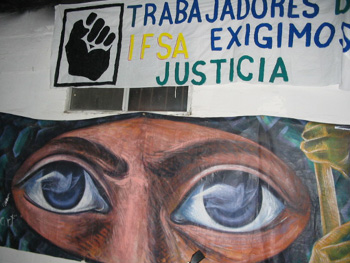


Maquiladoras in Tijuana
Maquiladoras in Tijuana
IntroductionFebruary 4th, 2004, Tijuana, Baja California
written by Johanne Pelletier and Francis Murchison
A little more than thirty years ago, Tijuana was a tourist town with a population close to 200,000. Now the population has grown to over a million. Its valleys, plateaus, and hills are covered with ramshackle housing and industrial parks. In the hope of finding work, thousands of deprived Mexicans and their families have abandoned their home states to migrate towards the North. There they can possibly work in one of thousands of maquiladoras or maquilas, which fill a band a few kilometers across that runs along the American border.
These outsourcing factories are subsidiaries of multinational corporations who have come to profit from the low cost of labor and a fiscal regime that is preferable for exports to the US where the majority of products are sent. Originating for the most part from the United States and East Asia, these companies can reduce their production costs ten times compared to those in the United States. What’s more, to attract foreign manufacturers, the Mexican government allows free access to water and electricity for two years. They have also built road systems and provide public services such as garbage collection to the industrial parks. They did not, however, go to nearly as many lengths for the general population in the colonias that surround the industrial zones.
In 1965, the Program of Border Industrialization (Programa de Industrializacion Fronteriza) undertook to provide a solution for the unemployment near the northern border of Mexico caused by the deportation of the Mexican laborers los braceros, from the United States. To this end, the Zona Libre was created, providing a zone where businesses received special treatment, leading to the creation of the first maquiladora. It is, however, with the signing of the North American Free Trade Agreement (NAFTA) that their numbers multiplied until they commanded a workforce of over one million people throughout Mexico.The growth of the maquiladora industry has led to the detriment of national industries, who were sold for the most part to foreign investors, hitting the primary national unions hard and destroying collective agreements (Contractos Colectivos de Trabajo). Currently, what’s left are mostly “ghost” unions who sell protection to the employers, signing collective agreements well below the standards set by the law. They thereby control and impede all organization of the workers in the maquilas.
Inside the factoriesAbove all, the maquiladoras are known for their lack of respect for human rights. The bosses disregard Mexican law and rationalize the use of their worker-merchandise. They maintain a rapid turnover of personnel in order to conserve low wages; few workers remain more than five years in the same factory, In 2003 wages averaged at 553 pesos ($50 US) a week while many factories offered remuneration of 50 pesos a day. In order to be hired, every woman must pass a pregnancy test and is obliged regularly to continue to do so. Working conditions that endanger health and security are prevalent as employees are exposed to toxic substances and dangerous materials without providing any protection and often causing work related accidents. Harassment, threats, and all sorts of techniques are used to pressure the workers into keeping up with a frenzied rhythm of production. After the age of 35, workers are declared too old to maintain a productive output and are therefore fired.
Furthermore, the employees who wish to defend their rights are rapidly fired and blacklisted. The factories where unions have managed to form close down and open again under a different name a few months later or move to a new location.
The Mexican constitution saw to the formation of an institution called the Junta Federal de Conciliacion y Arbitraje whose mission is to insure that workers rights are respected. This authority receives worker’s complaints and is charged to make judgment when litigation between a worker and an employer ensues after audiences between the parties have been assembled. However, corruption riddles the mechanisms of defense for the workers and the Chamber of Deputies’s Commission of Labor and Social Provision (Comision del trabajo y de prevision social) closes its eyes to offenses in the maquiladoras.
Here is a series of articles on three organizations that we met in Tijuana. These organizations struggle together against the exploitation that is happening in the maquiladoras, particularly on work issues, women’s conditions, and the environment. CITTAC (workers information center), women’s house Factor X, and the Colectivo Chilpanchingo tell us what it is they do.