

Maquiladoras in Tijuana - Factor X
Maquiladoras in Tijuana - Factor X
Casa de la Mujer- Factor X
Factor X, women’s’ centerMarch 17th, 2004, Tijuana, Baja California, Mexico
written by Johanne Pelletier and Francis Murchison
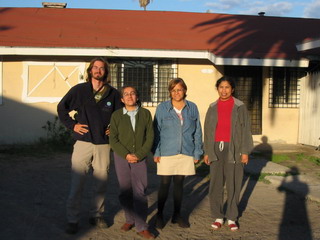
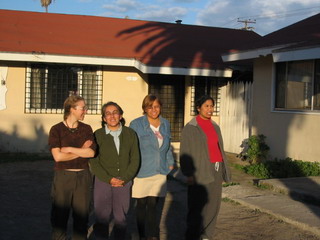
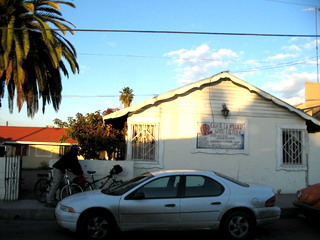
We showed up in the courtyard of the Factor X offices after a dusty ride through Tijuana’s hectic noontime traffic. Carmen Valadez, the general coordinator, welcomed us in amongst her colleagues, a lively and bustling group of women. We were taken on a tour through the rooms of the center, talking to the staff of enthusiastic feminists who introduced us to all the different things that they do. They showed us where the center’s services are offered as well as where the programs for research and empowerment take place. Carmen told us how the staff and volunteers here work with the larger aim of supporting the self-organization of the women workers or ex-workers of the maquiladora, as well as home-based workers. We spent the afternoon with these people who shared with us their experience in the struggle to change women’s conditions at work, at home, and in the community.
As a long-term activist for women’s rights, Carmen told us of how Factor X began in 1989. She was there when a group of friends, feminists, activists, and artists started to meet regularly in their own houses to address the prohibition of abortion in Mexico. In 1994, they began to work on the theme of maquiladoras because of the needs of the women workers. Currently, Factor X employs sixteen women and one man. Through their general activities, the center leads a permanent campaign to counter violence against women and distribute information about the rights and conditions of women in the factories. With the Cittac, they publish the Boletin Maquilero and work in a local network for maquiladora workers (Red Local de Trabajadores y Trabajadoras de la Maquila). As a member of the feminist and the worker movements, Factor X works to construct groups and networks focused on action, empowerment and solidarity. As such, they work with the Mexican Network of Female Workers in the Maquila (Red Mexicana de Trabajadoras de la Maquila), the Mexican Space of Organization in the Maquila (Espacio Mexicano de Organizacion en la Maquila), and the Maquila Solidarity Network.
Carmen walked us through the different spaces where the center’s services are offered. She explained how the support they receive through grants and funds and the volunteer work of many women makes it possible for the center to provide these services to women. We saw the modest clinic where women can receive low-cost medical exams, provided by three volunteer doctors. Dermatological help, pediatric attention for their children, and gynecological exams including family planning and contraceptives are offered. Psychological assistance is also available for women through individual therapy or self-help groups. Two lawyers provide free legal assistance to women who have problems in their factory and need to proceed to the Junta (labor court) as well as legal assistance for civil law such as divorces and child support.
Women’s number one hits
The matter of the maquiladoras is especially important as a women’s issue because young women between 18 and 35 make up the majority of the maquila workforce. As they need to prove that they’re not pregnant to get and keep a job in the maquila, women are pressured to resign if they are found pregnant. According to the law, pregnant women must be allowed to work only day shifts; away from any dangerous chemicals and in no event must they carry heavy objects. The enterprise needs to pay full salary to pregnant women, six weeks before and after the birth following the Federal Labor Law (Ley Federal del Trabajo). In spite of the law, pregnant women are given worsened working conditions and are subjected to increasing levels of harassment in an effort to pressure them to quit before the maternity leave. To avoid worsened treatment, women often hide their pregnancy and continue working in conditions that often cause miscarriages. Also, harassment of women is a daily occurrence in the factories and although it is an offence in Mexico, it is a criminal offence not to be tried in the labor courts. This makes suing for workplace harassment costly, complicated, and less accessible for women of the maquilas.
Investigation and diffusion: the mapping of home-based work
Ana Enrique was concentrating in front of her computer but left her work for a moment in order to talk to us. She told us about the current investigation project to research and map the home-based work industry in Tijuana. This three-year project will soon come to an end and aims to gather information about the invisible industry. The home-based work industry is made up mostly of women who are sub-contracted or self-employed and perform various tasks out of their homes in exchange for a cash income. For example, electronic maquiladoras looking to cut costs will sub-contract some cable assembly for home production.
Particularly in the case of sub-contracting, the conditions of the workers are worse than in the maquilas because they don’t have access to social security or other benefits. Furthermore, workers are isolated and lack social recognition, they are often defrauded or unpaid by their sub-contractors. Often, these women don’t even realize their work is considered as home-based work and they can be protected under Mexican law. HomeNet, an international solidarity network for home-based workers and their organizations, reports: “They (home-based workers) are not recognized as part of the workforce or as making an important contribution to the economy. Around the world, home-based work is on the increase, with the growth of sub-contracting and global marketing.”
Thus, the research project works to understand which kinds of home-based work exist in Tijuana, and help have it recognized as formal employment. At the same time, the investigators at the women’s center are attempting to prevent the eventual creation of a large-scale sub-contracting chain in Tijuana. Through home visits, distribution of newsletters and educational materials, Factor X endeavors to educate the workers about their industry and their rights. The information gathered in the inquiry is recompiled and given back to the workers to make it available for them if they wish to organize themselves.
Developing the skills for actionLupita, a maquiladora worker and promoter for Factor X, talked to us about her personal experience of humiliating working conditions. She told us how workers were required to check in at the office in the factory in order to get toilet paper to go to the washroom and were limited to five minutes or were accompanied by a supervisor. In Tijuana, electronic maquiladoras for well-known companies such as Sanyo and Panasonic have the lowest salaries. Working for a Korean electronic company, Lupita was forbidden from leaving her post to get a drink of water. As a mother of five, Lupita lives day to day in precarious conditions. Sometimes, the company subjects her to waits of up to twelve hours for her paycheck, withholding the funds she needs to get the bus home and sleep until her next shift. She also told us about a notable discrimination towards older or uneducated workers who have less employment possibilities in the maquila. This plays into the hands of the employers who impose the worst working conditions on them.
As promoter for empowerment, this thirty-year-old woman prepares and gives classes to women workers of the maquiladoras on labor and gender rights or assists those who face problems in the factory. If she witnesses an abuse in her workplace, when the boss pressures a worker to quit her job for example, Lupita informally discusses with the individual her rights without identifying herself as a promoter for Factor X. Lupita said that she had noticed how women are more likely to recognize their rights and defend them after they have participated in the empowerment workshops.
As feminists, our visit to Factor X made us proud to see what these women are doing. We are proud to see how they fight to change women’s conditions by providing the tools for women to empower themselves and organize in the maquila. The tools provided are various services specific to women as well as courses and workshops. Research and diffusion programming is an important tool, which is used to help workers break the isolation of the home and find solidarity amongst their peers. This very solidarity is what motivates the workers and the volunteers at Factor X to bring women to fight together against abuse and improve their working conditions. The abuse of women workers in the maquiladora industry and the home-based work industry won’t stop tomorrow but more and more women are becoming ready to react to this exploitation of labor and gender in Tijuana.
HomeNet- The International Network for Homebased Workers
http://www.gn.apc.org/homenet/Casa de la Mujer Grupo Factor X, A.C.
Junipero Serra, 14364 int. 1y 5
Fracc. Reynoso. La Mesa
Tijuana, B.C. C.P. 22460
Tels. (664) 622-4217 and 621-6422
Email: factorx@telnor.netColectivo Chilpancingo Pro Justicia Ambiental
Tel: (664) 647-7766Environmental Health Coalition
www.environmentalhealth.org