

Maquiladoras in Tijuana - CITTAC
Maquiladoras in Tijuana - CITTAC
Centro de Informacion para Trabajadores y Trabajadoras, Asociacion Civil.
Workers’ Information CenterFebruary 4th, 2004, Tijuana, Baja California
written by Johanne Pelletier and Francis MurchisonEn route to organizing the workers
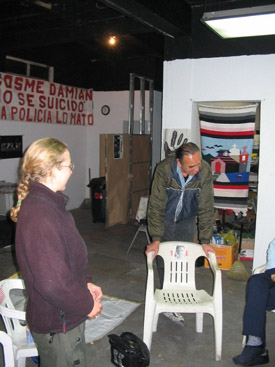
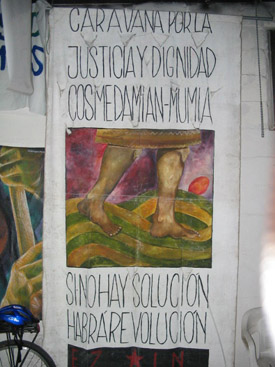
Located in the offices of the EZLN in Tijuana, the Center of Worker’s Information is comprised of over a dozen people who are past or present workers in the maquilas. Because the situation of these maquleros is precarious, involvement is off and on, fluctuating depending on job availability. Together, they do everything they can to create a movement. As such, they promote, support, and accompany the fights of workers in the maquiladora with the aim of seeing them organize themselves to defend their rights and improve working conditions.
Because they themselves have been victims of injustice in the maquilas, they have understood that they need to defend themselves against this exploitation. Joel, a maquila worker, told us: “When you don’t know the law, you can do nothing. Without knowing your rights, you can’t defend yourself. – Cuando no conoces la ley, no puedes haver nada. Sin conocer tus derechos no puedes defenderte.”
In fact, from their personal experience, they have understood that lawyers who represent them at the Junta de Conciliacion y Arbitraje do it for the business and not for the protection of workers’ rights. The tendency is to accept an amount that is less than what the law requires, arranging things quite well for the employers as well as the lawyers who can have a larger number of cases and fill up their pockets nicely.
Cittac provides free legal assistance for workers who solicit it. More than twenty demands are currently underway. With knowledge of the law, they manage to impart a legal resistance through their stubborn insistence that the law be applied justly. They have had much success in representing the workers, since even the employers who were used to giving lower settlements and fixing everything with money, didn’t have good lawyers. In fact thanks to this legal resistance, employers now offer higher settlements when they are taken to the Junta.
In 1993, an ad boasted of the maquiladora industry’s twenty-five year experience in Tijana. Jaime Torres, legal assistant at Cittac, told us, “They had 25 years of experience exploiting us but we didn’t have 25 years of experience in organization, defending ourselves. – (Tienen) 25 anos de experiencia explotandonos y nosotros no tenemos 25 anos de experiencia en organizacion defendiendonos.” That same year they began to investigate previous resistance in the maquilas and to learn from the past. Their experience grows with this historic consciousness that accumulates as the research continues, and they have already amassed a large quantity of information. “We never thought, when we started out, that we would investigate history, but we ended up studying history. We’re lawyers without being lawyers and we’re researchers without being historians. – Nunca habiamos pensado cuando nos formamos que ibamos investigar historia, pero resulto que estamos investigando historia. Somos abogados sin ser abogado, somos investigadores sin ser historiadores. »
What’s more, Cittac distributes information in order to make known worker’s rights. At the exit of the maquilas, they give out the primero auxilios laborales, a pamphlet on a worker’s primary rights. As a member of la Red Local de Trabajadoras y Trabajadores de la Maquila (Local Maquila Workers Network), they participate in the publishing of the Boletin Maquilero (Maquila Worker’s Newsletter) that provides a medium through which the workers can be heard. They are also continuously preparing workshops on empowerment, worker’s rights, and gender issues.
For the time, the movement is small and quite on the defensive. The struggles happen on an individual basis, for example after an unjust firing in a factory; this is not yet at a level high enough to change the working conditions or have workers’ rights be respected. The Information Center endeavors to build solidarity with other organizations in Mexico and the United States. Jaime told us, “The problem of the maquiladora industry cannot be resolved solely by the workers in the maquiladora industry because the maquila worker isn’t faced with the traditional boss who was found previously here in Mexico or elsewhere. Rather, they are confronting the big Trans-National Corporations; as such they are confronting global power. The only way for it to really work is for this movement in the maquila to be unified with other social movements. Consequently, all the circumstances must be created for the (working) conditions to really change. Those alone, those who are inside the factories, cannot change it. – El problema de la industria maquiladora no la pueden resolver solamente las trabajadoras y los trabajadores de la industria maquiladora porque el trabajador de la maquila no se esta enfrentando al patron traditional que habia antes aqui, en Mexico, o en otros lugares. Sino se estan enfrentando a los grandes transnationales, se estan enfrentando por tanto al poder mundial. La unica forma como realmente se puede es que ese movimiento en la maquila esté unido a otros movimientos sociales. Entonces, hay que crear todas estas condiciones para que realmente cambian las condiciones. Ellos solos, los que estan a dentro de la fabrica, no lo pueden cambiar.»
Overall, the Cittac works bit by bit with all the tools available to create a movement in Tijuana that will face the system of capitalist exploitation, which has achieved its ideal in the maquiladora industry. The goal is broad and admirable. In order to proceed, they provide legal assistance to workers, distribute information, and busy themselves building solidarity with organizations in Mexico and the States. As such, speaking of the current system, Jaime maintained, “ What’s important is to organize the people (workers). If they (investors) want to come here and invest, let them come, but respect our laws. They cannot do this. So, if you’re being logical with the question that the firms must respect Mexican law and must respect human rights, practically what you’re saying is that these businesses should not exist. – Lo que importa es de organizar la gente (los trabajadoras-es). Si quieren venir invertir, vengan, pero respetan nuestras leyes. No lo pueden hacer. Entonces si tu estas haciendo consecuente con la cuestion de que las empresas deben respetar las leyes mexicanas, deben respectar los derechos humanos. Tu practicamente lo que estas diciendo es que esas empresas no deben de existir.»
Centro de Información para Trabajadoras y trabajadores, A.C.
Dolores 32 B
Fracc. Dimenstein
Tijuana, Baja California, México.
tel: (664) 622-4269
cittac@telnor.net
www.cittac.org
Colectivo Chilpancingo Pro Justicia Ambiental
Tel: (664) 647-7766Environmental Health Coalition
www.environmentalhealth.org