

Cascadia Wildlands Project
Cascadia Wildlands Project (CWP)
january 24th, 2004, Eugene, OREGON, USA
by Johanne Pelletier and Francis Murchison
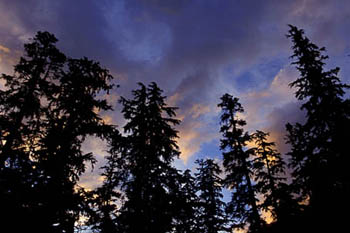
Picture by Brett ColeThe bioregion of Cascadia extends from Northern California to the southern tip of Alaska. This majestic forest stretches along the West Coast, following North America’s Rocky Mountains. The dominant species such as Douglas Fir, Western Hemlock, and Western Red Cedar are known around the world for their impressive height and their grand trunks that can reach several meters in circumference. The old growth forest not only shelters a significant fauna, but also protects a vast watershed where many species of salmon and other anadromous fish spawn. Cascadia’s old growth forests have undergone drastic logging, principally between the 50’s and 80’s. Only a small portion of the primary forest remains and unfortunately the logging continues.
In 1997 a group of experienced forest conservation activists mobilized to put an end to old growth logging in order to protect the remaining patches of primary forest. Based in Eugene, Oregon, this small organization “packs a punch” with its three full time and two part time employees. A large part of their work is done through public education. They do presentations in schools, on University campuses, in old folks homes, to unions, and in community centers. Almost every week, they organize hikes out to the old growth forest to show people which woods are slated for logging as well as those that have already fallen under the saw blade. “People are really expressing interest and concern about seeing these last stands of old growth forest upright rather than horizontal,” said Josh Laughlin of CWP. In fact, the organization has had considerable success in bringing the public and policy makers to deforestation sites to show how old growth logging is still going on.
Projects for forest ecosystem restorationBesides working for public awareness, the Cascadia Wildlands Project has proposed projects to the Forest Service, pushing forward restoration projects in young managed stands. These areas were logged over fifty years ago and are now growing back in even-aged stands. The organization promotes an approach called Variable Density Thinning. This strategy involves thinning by small patches in an attempt to reintroduce some structural complexity to the even-aged stands. This approach to thinning aims to recreate the chaos found in old growth forests in order to reinstate an enviable habitat for species such as the northern spotted owl. Their project hopes to favor the creation of jobs in forest restoration, allowing some volume of wood to be cut without much controversy, while avoiding the less desirable even-aged forests.
The Clinton Administration’s Northwest Forest PlanWith the goal of stopping old growth logging, CWP advocates in cases of environmental litigation. In order to proceed, they use the Northwest Forest Plan, which was enacted during the Clinton administration to resolve the crises of the Spotted Owl, the old growth forest, and of unemployment in the logging industry. The plan was supposed to be well balanced in order to serve all these interests. In fact, it did set aside a lot of primary forest for spotted owl habitat while integrating the conservation of the Cascadian watershed. The Northwest Forest Plan also gave the organization a legal tool with which to sue in order for the Forest Service and the buyers to respect the environmental clauses of the plan. The plan did, however, leave over a million acres of mature forest up for grabs to be logged, and this is where old growth trees are currently being cut.
The Bush Administration’s destruction of the Northwest Forest PlanRecently, the Bush administration has proposed a reduction in the environmental protection of old growth forests. As if in payback for the money he received from the logging companies during his election campaign, the Bush administration is reworking the Northwest Forest Plan. Among other things, the reworked plan attempts to gut two key environmental components in amending the Survey and Management Strategy as well as the Aquatic Conservation Strategy.
First of the two, the Survey and Management Strategy, requires the Forest service and the BLM to research for the presence of rare or endemic species inside the areas to be cut and to protect these species if they are found. There are more than 300 species on the Survey and Management Strategy’s list including some species that aren’t included in The Endangered Species Act. An example of this is the red tree vole, a little known species about which more information is currently being gathered. The Forest Service therefore needed to verify for the presence of these species before proceeding with a timber sale. This slowed down efforts to plan timber sales of old growth forests, which are rich in biodiversity. The timber industry has sued the government, claiming that they only need to follow the Endangered Species Act. In reaction, the Bush administration is eliminating the Survey and Management Strategy.
Second to be chopped is the Aquatic Conservation Strategy. This provided protection for salmon and some other species of fish. The Bush administration proposes to no longer require the Forest Service and the BLM to demonstrate that the logging of planned timber sales will have no impact on streams or fish. The Aquatic Conservation Strategy had already allowed the CWP along with other local groups to put over a dozen timber sales on hold because they violated the clause.
And the cutting continues…On the road, we met many people of all ages who were extremely concerned about the situation in the forests. Activists who had just spent months up in the trees shared their disappointment with us about the lack of attention paid to their demands. We also crossed paths with many logging trucks, transporting great trunks that from the old growth forests. Although the forest can grow back, a tree with an eight-foot diameter will never be replaced in a single human lifetime.
What’s more, even in encouraging a forest management according to the a la mode concepts of sustainable development; environmental, social, and economic interests don’t receive the same attention. Economic interests are given the place of honor in spite of the demands of citizens. Governments continue to embrace neo-liberal values as the only path to follow. It’s a simple equation: forest resources are limited and in order to continue making a profit, companies must log in ever-increasing quantities. What follows is the disappearance of old growth forest. The trend observed in the North is generally of governments who submit to the logging companies because of menaces of layoffs, following the myth that they are the only ones capable of creating jobs. In the South, the companies move to new locations, following the forest and the low cost of labor.
However, several examples show that the fight to slow the cutting has had positive results on a local level. What remains is for more people to organize in order for interests other than economic interests to be respected and to join Cascadia Wildlands Project in an effort to protect old growth forests.
Cascadia Wildlands Project
P.O. Box 10455
Eugene, OR 97440
Tel.: (541) 434-1463
Fax : (541) 434-1465
www.cascwild.org
cascwild@efn.org